Benjamin Cunningham · Moreland University · ED504 · Behavior Improvement Plan for a case-study ELL · Prathom 5, Rattanaburi, Surin · October 18, 2026 · Shared with my Methods instructor
For submission in the module's format: the plan on the Moreland Behavior Management Plan template (Word), with the five numbered sections, the ESL Methods strategies and the reflection appended. This page is the full version with the data and the research. The case study is my own student rather than the module's "Renee" option, as the brief allows, because an ESL plan belongs with an English learner.
The student
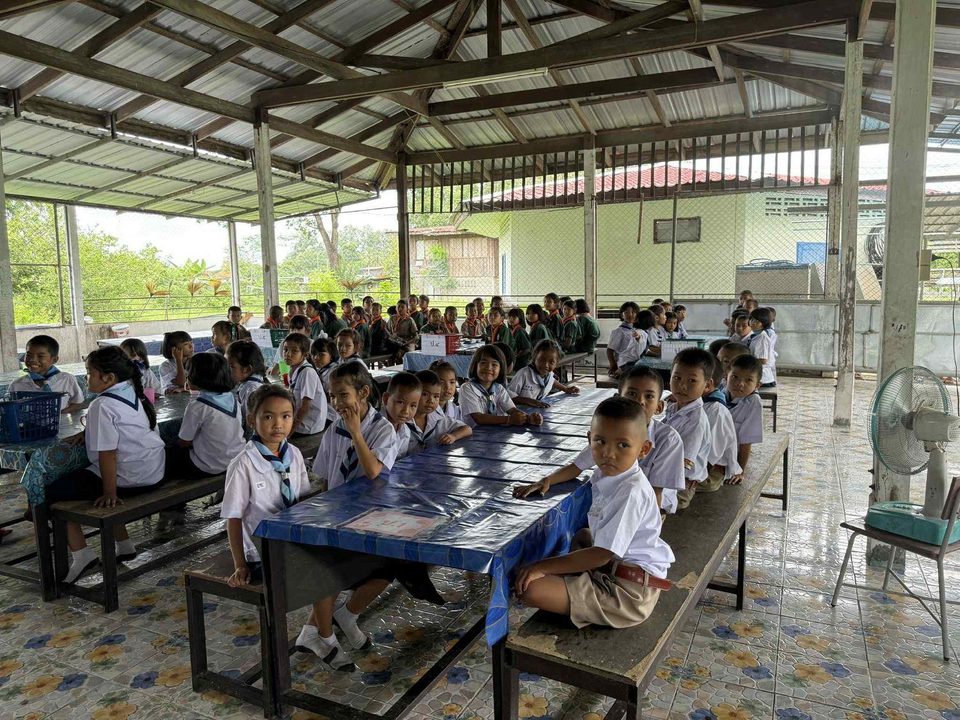
Case study: "Tee" (a pseudonym; details changed and combined so that no child can be identified). Tee is eleven, in Prathom 5 at a government village school in Rattanaburi district, Surin, Thailand. He lives with his grandmother and a younger sister; his mother works in a Bangkok factory and comes home for the harvest and Songkran, his father works on the Eastern Seaboard. At home the family speaks Isan (the Lao of the Northeast); Tee speaks Thai fluently but reads it at about a Prathom 2–3 level, and in English he is at WIDA level 1, Entering: he knows the alphabet, some classroom words and numbers, and understands more than he says. He is up at five most mornings to move the family's cattle before school, and he eats at school for the first time most days. Presume, as the Methods brief asks, that Tee is an English language learner: in my room he is one in Thai and in English, and the plan is written so that the same Tee, arriving in a Washington, DC classroom with Isan and Thai and no English, would be served by the same logic.
Strengths first. Tee is the best oral storyteller in the class in Isan; he can hold thirty children with a cattle story. He is quick with money and weights at the market, knows the rice calendar better than I do, plays football with authority, and sings mor lam verses his grandmother taught him. The boys follow him. He is kind to his sister and to the youngest children at the school. Every strength on that list is a lever in this plan, because a behavior plan that only subtracts behaviors leaves a child with nothing to be good at.
How the plan was built. Two weeks of ABC data (antecedent, behavior, consequence) kept by me and my Thai co-teacher on the Step 6 incident form; the learner survey from Step 2; the strengths card and a home visit from Step 7, with my co-teacher interpreting in Isan; a conversation with Tee himself in Thai; attendance and arrival times from the register; and the Friday word-wall data. The grandmother signed the Thai consent for the data and the plan, as Thailand's Personal Data Protection Act (2019) requires for a child under ten and good practice requires for any child. The plan follows the functional behavioral assessment logic of positive behavior support (Crone, Hawken and Horner, 2015): define the behavior, find its function, teach a replacement that serves the same function, change the environment so the replacement works better than the problem, and measure.

Baseline: what the ABC data showed
Over ten school days (six English lessons a week, plus the transitions around them), Tee's six problem behaviors clustered around three conditions: the first lesson of the day; any task whose text was only in English; and transitions with no job for him. The most common consequence of each behavior was attention (laughter from the boys, a public correction from an adult) or escape (the task was quietly dropped). Both consequences were paying the behavior. The Maslow reading (Step 8) is consistent with the function data: physiological needs in the mornings (he has walked the cattle and not eaten), esteem needs around English text (he cannot do the task and will not be seen failing), and belonging and status needs in the teasing and the clowning (the boys' laughter is the currency he has). None of the six behaviors was dangerous. One (teasing) harmed other children and is the priority.
1. The disruptive behaviors (six), defined and measured
| # | Behavior, defined so that two adults would count it the same way | Baseline (two weeks) | Typical antecedent | Typical consequence | Hypothesized function |
|---|---|---|---|---|---|
| B1 | Calling out: speaking without a signal during teacher instruction, including jokes, answers and comments to peers loud enough for the class to hear | Average 8 per 50-minute lesson (range 4–13) | Whole-class instruction longer than five minutes; a question he knows the answer to in Thai | Laughter from the boys; "Tee, quiet" from an adult | Attention and status (belonging); sometimes to show competence he cannot show in writing |
| B2 | Out of seat: leaving his place during independent or pair work without permission, wandering to other tables, for more than ten seconds | On task in 45% of observed intervals during independent work; out of seat 5–6 times a lesson | Independent work with an English-only worksheet; afternoons; after twenty minutes seated | Peer interaction at other tables; the task not completed and not followed up | Escape from a task he cannot read; movement (physiological); social contact |
| B3 | Work refusal: head on the desk, worksheet pushed away, or "mai tham" ("not doing it") within two minutes of an English reading or writing task; no attempt in five minutes | In 7 of 12 lessons with an English text task | A text at or above WIDA 2 with no Thai gloss; being asked to read aloud | Task removed or left; adult attention (coaxing) | Escape from failure in front of peers (esteem) |
| B4 | Teasing and mocking: imitating a classmate's English pronunciation or reading, laughing at a mistake, or a put-down in Thai or Isan ("ngo", stupid) directed at a peer | Average 3 incidents a day; 2 children targeted repeatedly | A peer reading aloud or answering in English; the boys' table watching | Laughter; the target goes quiet; a public reprimand | Status in the peer group (belonging and esteem); deflecting from his own English |
| B5 | Transition disruption: during a Step 4 transition, the slow walk after the signal, pulling or kicking chairs, pushing in the line, or starting a game; transition not completed in the target time because of him | In 60% of transitions; 4 chair or pushing incidents in two weeks | A transition with no job for him; a signal given by voice only; the end of a lesson he found hard | Laughter; the whole class delayed; a reprimand by name | Attention; escape from the next task; movement |
| B6 | Late and unready mornings: arriving after 8:30, or arriving on time with head down and no engagement in the first lesson; no materials out in the first ten minutes | Late 3 of 5 days; head down in the first lesson 4 of 5 days | Cattle duty before school; no breakfast; a late night when the mother calls | Left alone (nobody expects anything of him until 9:30) | Physiological (hunger, sleep); the first lesson has become a place where nothing is asked and nothing is given |
Priority order: B4 first, because it harms others and poisons the climate for the whole class's English; then B3 and B6, which are the needs behind most of the rest; B1, B2 and B5 are expected to fall as the first three are addressed, and are measured anyway.
2. SMART goals (seven)
Each goal is specific, measurable with a tool named in section 5, achievable from the baseline, relevant to the function of the behavior and to Tee's learning, and time-bound within one eight-week cycle (weeks counted from the plan's start on a Monday).
| # | Goal | Specific and measurable | From (baseline) → to (target) | Relevant because | By when |
|---|---|---|---|---|---|
| G1 | Tee gets attention by raising his hand or using his help card instead of calling out | Call-outs per lesson on the tally; hand-raises and card uses counted alongside | 8 call-outs a lesson → 2 or fewer in 4 of 5 lessons; hand-raise or card used at least 5 times a lesson | Replaces the attention function with a behavior the whole class can live with | End of week 8 (interim: 5 or fewer by week 4) |
| G2 | Tee stays on task during independent work, using the break pass when he needs to move | Momentary time sampling, 1-minute intervals over 10 minutes, twice a week | 45% on task → 80% on task in 3 of 4 observations; break pass used no more than twice a lesson | Gives the movement and escape functions a sanctioned route and removes the wandering | End of week 8 (interim: 65% by week 4) |
| G3 | Tee starts every English reading or writing task within two minutes, using the Thai-gloss version or his buddy | Task-start latency and completion recorded by the co-teacher on the daily card | Refusal in 7 of 12 lessons → task started within two minutes in 4 of 5 lessons and completed at his level in 3 of 5 | Replaces escape with success: the task is made doable at WIDA 1 before it is asked for | End of week 6 (interim: 3 of 5 by week 3) |
| G4 | Tee gives peers positive feedback in English or Isan and does not mock | Mocking incidents on the ABC log; "tootling" slips (peer-praise notes) counted weekly | 3 incidents a day → zero mocking incidents for three consecutive weeks; at least 3 recorded peer-help or peer-praise acts a week | Keeps the status function (he is still the boy others look to) and turns it toward the group | Zero streak achieved by end of week 8 (interim: 1 or fewer a day by week 3) |
| G5 | Tee completes transitions in the target time with hands and feet to himself, in his transition job | Transition timer log (Step 6) and a yes/no on the daily card for each transition | Disrupting 60% of transitions → 90% of transitions completed in time without incident; zero chair or pushing incidents for four weeks | Gives him the job (timer and door) that supplies the attention and movement he was taking | End of week 6 |
| G6 | Tee arrives ready: on time, fed, materials out, first task started | Register arrival time; the morning check-in card (breakfast taken, materials out, Do-Now started) | Late 3 of 5 days and unready 4 of 5 → on time 4 of 5 days and ready (all three boxes) 4 of 5 days | Meets the physiological need that drives the morning behavior and gives the first lesson back | End of week 8 (interim: on time 3 of 5 by week 4) |
| G7 (academic) | Tee's English grows visibly while the behaviors fall | Friday word-wall quiz (Plickers); a WIDA 1 text read to a partner; one class-book page authored | 9 words owned → 40 words owned; reads a 40-word leveled text aloud to his buddy; one page in the class book in his own words with the Isan beside it | The plan is a failure if behavior improves and learning does not; esteem comes from real competence | End of week 8 |
3. Target replacement behaviors (six), and how each is taught
A replacement behavior has to do the same job for Tee as the problem behavior did, more easily. Each one below is taught explicitly (tell, show, practice in Thai and Isan, practice in the real setting), cued before the moment it is needed (precorrection), and reinforced the first fifty times it appears (Cooper, Heron and Heward, 2020; Simonsen et al., 2008).
| Replaces | Target replacement behavior | How it is taught | Cue or prompt | Reinforcement |
|---|---|---|---|---|
| B1 calling out | R1. Hand up, or the help card. Raise a hand and wait; or place the trilingual help card (English, Thai, Isan: "I have an idea" / "I need help") on the desk and keep working | Role-played with the co-teacher in Isan: three rounds of "what do I do when I know the answer?"; the whole class practices the same routine so Tee is not singled out | The card on the desk every lesson; precorrection at the start of instruction: "Hands or cards, Tee is my card man today" | Called on within ten seconds of a hand or card for the first two weeks (then on a thinning schedule); ClassDojo point "hands or card"; behavior-specific praise in private |
| B2 out of seat | R2. The break pass. Take the laminated pass, walk to the water and back (two minutes), return to the task; twice a lesson at most | Taught as a class routine (Step 4): everyone has a pass; the walk and the return are practiced | The pass on the desk; the Classroomscreen timer for the two minutes | Returning on time is logged on the daily card; the next on-task interval earns a point |
| B3 work refusal | R3. "Thai version, please" and the first-two-minutes start. Ask for the Thai-gloss worksheet (ESLteacher.com builder, WIDA 1 level) or ask the buddy in Isan what the task is, then start the first item | Shown that the Thai-gloss version exists for every task and is not a "baby" version (the buddy uses it too); the first item is modeled; "do three, show me" is the routine | The gloss version placed on his desk before the English one; the buddy seated beside him; the two-minute timer | Starting within two minutes earns the "started" box on the card; completion at his level is shown to the grandmother on Friday by voice note |
| B4 teasing | R4. Tootling: catch a classmate doing well. Write (or tell the co-teacher) one thing a classmate did well in English each day on a tootle slip, in any language; respond to a peer's mistake with the class phrase "mai pen rai, try again" or silence | Taught to the whole class as the Good Behavior Game with ClassDojo (Lynne et al., 2017) and tootling (Dillon et al., 2019); Tee practices the response to a mistake in role-play with the co-teacher first | The tootle box on the teacher's desk; the class phrase on the wall in three languages; precorrection before any reading aloud: "Listeners' job: find something good" | Tootle slips read aloud on Friday (his name as the writer, in front of the boys); a class reward when the class reaches 50 slips; a mocking incident costs nothing publicly but triggers the restorative conversation below |
| B5 transitions | R5. The transition job. Be the timer-and-door monitor: start the Classroomscreen timer on the signal, stand at the door, count the class through, report the time | Walked through three times with the co-teacher; the job is real and visible; a backup job (materials) for days the timer is not needed | The job card on his desk; the signal is seen and heard (Step 4) | The transition time announced by him; the class's transition point is partly his; the job rotates only when he asks |
| B6 mornings | R6. The morning routine. Arrive, take something from the snack shelf, check in with the co-teacher (two sentences in Isan), materials out, Do-Now on the screen started | Practiced on day one with the co-teacher; the check-in is warm and short; the grandmother agrees the routine at the home visit | The snack shelf open at 8:15; the check-in card with three boxes; the co-teacher at the door | Three boxes ticked earns the morning point; the week's mornings are the first thing in the Friday voice note home |
4. The strategies: prevent, teach, reinforce, respond
Antecedent strategies (prevent). Every English text Tee meets exists at WIDA 1 with a Thai gloss and a picture before the lesson (the ESLteacher.com builder makes the three-level version in twenty seconds); instruction is never longer than five minutes before a pair task; he has a job in every transition; the first lesson of the day is active and begins with food; the boys' table is split into pairs with jobs, and Tee's partner is Nok, who speaks Isan and reads Thai well, chosen for warmth; the signals are seen and heard; the schedule is on the screen; reading aloud is never demanded of anyone without rehearsal with a partner first; and the Isan line on the word wall is his to fill in, so that the language he is best at has status in the room.
Teaching strategies. The six replacement behaviors are taught in the first week as class routines, not as Tee's special program, with Tee given the roles that make him the model (card man, timer, door). The co-teacher runs the Isan role-plays. Self-monitoring is taught in week 2: Tee keeps his own tally of call-outs and hand-raises on a card; when his count matches the teacher's within two, he earns a bonus point, which trains accuracy and awareness (Bruhn, McDaniel and Kreigh, 2015).
Reinforcement. A check-in/check-out cycle (Hawken, Crone, Bundock and Horner, 2020): morning check-in with the co-teacher, a daily card with the six behaviors scored by lesson (0, 1, 2), afternoon check-out, the card home in the folder, and a Friday review. ClassDojo carries the same categories so the grandmother sees them; points buy nothing material: they buy time and roles (five minutes of football with me, the camera on the Friday stage, reading his class-book page to the P2 children, choosing the week's mor lam line for the pronunciation drill). Behavior-specific praise is private ("You used the card three times, that is exactly it"); public praise is for the group he is in. The ratio I hold myself to is four positives to every correction (Simonsen et al., 2008).
Response to problem behavior (the ladder). Call-outs are not answered; the next hand or card is answered at once. Wandering gets a silent point to the break pass. Refusal gets the gloss version and "do one, show me", not coaxing. A transition incident is redone calmly after the lesson, once, with the job restored next time. Teasing is the one behavior with a planned restorative consequence: a private conversation the same day in Thai with the co-teacher present (what happened, who was affected, what will you do), a repair the target accepts (an apology or a tootle slip for that child), and the Friday reading of tootles unaffected, because the goal is to make him the boy who notices good English, not to take the stage away. No public correction, no name on a board, no loss of break or lunch, no corporal punishment (illegal in Thai schools since 2005 and inconsistent with everything here). Safety plan: none of Tee's behaviors is dangerous; if pushing ever became hitting, the co-teacher removes the audience, not the child, the head teacher is told the same day, and the student support system's screening applies.
Online classroom. If the school closes, the same plan runs on Zoom and Google Classroom (Step 6): the help card becomes the raise-hand button, the break pass is a camera-off two minutes, the Thai-gloss task is posted before the lesson, the transition job is the chat monitor, the morning routine is the first five minutes with the co-teacher in a breakout room, and tootles go in the chat.
5. Culturally and linguistically relevant strategies, materials and tools
This section answers the Methods brief directly: the strategies that make the classroom more culturally and linguistically relevant for Tee, and the instructional strategies, materials and tools that support each goal. The frame is culturally relevant pedagogy (academic success, cultural competence and critical consciousness; Ladson-Billings, 1995), culturally responsive teaching, which uses the cultural knowledge, prior experiences and frames of reference of students to make learning more effective (Gay, 2010), the neuroscience version of it, in which relationship and cultural familiarity lower the threat response that blocks learning (Hammond, 2015), and culturally sustaining pedagogy, which keeps the home language and culture in the room rather than using them as a bridge and discarding them (Paris and Alim, 2017). In second-language terms, every strategy is also a way of lowering the affective filter (Krashen, 1982) and of letting Tee use everything he knows in every language to learn (translanguaging; García and Wei, 2014; Cummins, 2001).
| Goal | Culturally and linguistically relevant strategy | Materials and tools | Why it fits Tee |
|---|---|---|---|
| G1 hands or card | The help card and the class phrases exist in English, Thai and Isan; Tee's Isan version is the one the class copies. Asking for help is reframed as the expert's move, not the weak child's: in Isan village life asking an elder is respect, not failure | Trilingual cue cards (printed from the EnglishTeacher.com word lists plus the Isan line written by Tee); the class phrase wall | Puts his strongest language on the card and makes him the author of the routine |
| G2 on task | Independent work includes a choice of topic from his funds of knowledge (cattle, the rice calendar, football, the market) so the task is worth staying for; movement is built in, as it is in his working day | ESLteacher.com worksheets built on his topics at WIDA 1 with Thai gloss; the break pass; the Classroomscreen timer | A boy who moves cattle at dawn is not a boy who can sit for forty minutes; the plan stops pretending otherwise |
| G3 start the task | Translanguaging as policy: the task may be understood in Isan with the buddy, planned in Thai, and produced in English; the Thai-gloss version is the normal version, used by half the class | The three-level text with Thai gloss and transliteration; the buddy (Nok); EnglishTeacher.com on the television for the pronunciation of the task's key words | Removes the "English-only or nothing" trap that produced the refusal |
| G4 no mocking, tootling | Status in Thai and Isan culture is relational: face (naa) is given and taken in front of others. The plan gives Tee face for noticing good English (his tootles read aloud) and protects others' face by banning public correction for everyone, including by the teacher. "Mai pen rai, try again" is the class's own Thai phrase, not an imported rule | Tootle slips in three languages; ClassDojo Good Behavior Game; the class phrase on the wall; the USAEnglish.com score sheet, so that peer feedback on the Friday stage is specific (voice, eye contact, story, language) rather than mockery | Converts the status he already has into the currency the room needs; respects the culture's rules about face instead of fighting them |
| G5 transitions | The job carries real responsibility in front of the group, which is how status is earned in his village (the boy who is trusted with the buffalo); the signal is a visible one, and the routine is explained in Isan by the co-teacher so there is no language gap in the instruction itself | Classroomscreen timer and door job card; the transition routine from Step 4 with its Thai and picture versions | Attention and movement, legitimately, in the role of the trusted boy |
| G6 mornings | Food first, without stigma, because the village's children eat at school and that is nobody's shame; the check-in is in Isan, warm, two sentences, with an adult who knows his grandmother; the first lesson opens with the mor lam line of the week, the rhythm Tee already owns, used to teach English stress | The snack shelf; the bilingual morning card; the mor lam line on the screen with the English line under it; EnglishTeacher.com's Ploy Hears for the sound of the day | Meets the need before the lesson, in his language, through his music |
| G7 learning | Identity texts: Tee's class-book page is his grandmother's cattle story, told in Isan, written in English with the Isan beside it, read on the Friday stage; the content of his English is his life, and the Story Telling competition is a stage the village recognizes | The grandparent interview sheet (Step 7); the recorder on this portfolio for the listening corner; the class book; USAEnglish.com's lesson plans and Thai parents' page; Plickers for "words I own" | Oral strength becomes written English; the family becomes the content; achievement is visible to the people whose opinion he cares about (Cummins and Early, 2011) |
Making the whole classroom more relevant, not only Tee's seat. The trilingual word wall with the children's own lines; the three-level library with the village's stories in Box C; the Isan, Kui and Khmer greetings used at the door; the class agreements written together in Thai and English; the Friday stage with the district competition's own score sheet; the families as co-teachers of content (Step 7); the Buddhist and farming calendar in the planning (nothing demanding in the harvest); private correction as the rule for everyone, which is both good behavior management and respect for face; and the co-teacher as the Isan voice of every routine. A culturally relevant classroom is one in which Tee's English teacher knows what a buffalo is worth, and Tee knows that his teacher knows.
6. Methods to monitor the plan (eight)
| # | Method | What it measures | Who, how often | Decision rule |
|---|---|---|---|---|
| M1 | ABC incident log (Google Form, Step 6, with the "need" column) | Every B4 incident and any other incident: antecedent, behavior, consequence, need | Both teachers, every incident, same day | Three B4 incidents in a week after week 3 triggers a plan review |
| M2 | Frequency tally of call-outs, hand-raises and card uses (paper tally or the Classroomscreen counter) | G1 | Co-teacher, three lessons a day | No fall by week 4 means the attention function is not being met: shorten instruction, increase the rate of calling on him |
| M3 | Momentary time sampling, 1-minute intervals over 10 minutes of independent work | G2 on-task percentage | Me, twice a week, different days | Below 65% at week 4 means the task is still too hard: check the gloss version is really on his desk first |
| M4 | Daily check-in/check-out card (six behaviors scored 0–2 per lesson; three morning boxes) | G1–G6 daily; the morning routine; the home signature | Co-teacher morning and afternoon; home every night; Friday review | 80% of available points for four consecutive weeks begins the fade (section 8) |
| M5 | Tee's self-monitoring card compared with the teacher's count | Accuracy of his own awareness; G1 | Tee every lesson from week 2; compared Friday | Match within two earns the bonus; a persistent gap means the behavior is not yet visible to him and precorrection increases |
| M6 | Transition timer log and the daily card's transition line | G5; whole-class transition time | Tee (as timer) and the co-teacher, every transition | An incident in a transition where he had no job means the job rota failed, not Tee |
| M7 | Register arrival time; breakfast and readiness boxes | G6 | Co-teacher daily | Late three days in a week triggers a LINE voice note to the grandmother and, if it continues, a visit |
| M8 | Academic probes: Plickers word-wall quiz; the partner reading; the class-book page; tootle slips counted | G7 and G4 | Weekly (Friday) | Behavior up and words flat by week 4 means the plan is managing him, not teaching him: revise the texts and the time on EnglishTeacher.com |
The review cycle. Friday, ten minutes, me and the co-teacher: the week's card totals and tallies graphed on one sheet (a line for each goal against its target); one decision per goal (continue, adjust, fade); one line to the head teacher in the monthly page; one voice note to the grandmother. A formal review at week 4 with the grandmother and Tee, and at week 8. Fidelity: once a fortnight the co-teacher checks five things about me: gloss version on the desk before the task, call-outs ignored and hands answered, precorrection given before instruction, private not public correction, four positives to one correction. A plan that is not run is not a plan that failed.
7. Family communication (seven forms, platform and frequency)
The family is Tee's grandmother at home (reads little Thai, uses LINE voice notes), his mother in Bangkok (reads Thai, has LINE), and his father on the Eastern Seaboard (LINE, irregular). Everything goes out in Thai, by voice where reading is a barrier, and the first message is good news (Step 7). Nothing about Tee goes in the class group.
| # | Form | Platform | Frequency | Language and who | What goes out, what comes back |
|---|---|---|---|---|---|
| F1 | Home visit to plan together | In person, at the grandmother's house, within the school's student support system | Week 1, week 8, and each term after | Isan and Thai; me and the co-teacher; Tee present | The strengths card; the plan explained in Isan; the consent; the grandmother's own goal for Tee (she asked that he "read the temple notices"); her agreement to the morning routine |
| F2 | Daily card home and back | Paper, in the folder | Every school day | Thai with pictures; signed with a tick by any adult | The day's points and one good thing; back with a tick and sometimes a note from the sister |
| F3 | Friday voice note | LINE, one-to-one to the grandmother | Weekly, Friday afternoon | Thai, recorded by the co-teacher; 60 seconds | The week's mornings, the tootles he wrote, the words he owns; a question for the weekend; her voice reply |
| F4 | "Tee reads to me" video call | LINE video call from the classroom to the mother in Bangkok (and the father when he can) | Monthly, plus the week-4 and week-8 reviews | Isan and Thai; Tee leads | Tee reads his class-book page or the week's text; the mother asks one "Ask me about" question; her voice note goes in his folder |
| F5 | ClassDojo family connection | ClassDojo app on the grandmother's phone (set up at the home visit); messages translated to Thai | Points visible daily; a message weekly | Thai; both teachers | The same six categories as the card; the Class Story shows the class's tootle total, never an individual's incidents |
| F6 | Same-day call for anything serious, and a positive call every two weeks | Phone call (co-teacher) | As needed, same day; positive call fortnightly | Isan; co-teacher | A teasing incident with a repair done is reported the same day as "what happened and what he did about it"; the fortnightly call has no agenda but good news |
| F7 | Term parents' meeting and student-led conference; goal card | In person at school (or by video for the mother) | Each term; the goal card re-signed every four weeks | Thai and Isan; Tee presents | Tee shows his graph, his words owned and his page; the family sets the next goal; the card goes home signed |
8. Team, timeline, fading and generalization
| Week | What happens |
|---|---|
| 0 | Two weeks of ABC baseline; home visit (F1); consent; buddy chosen; gloss texts prepared; snack shelf stocked |
| 1 | Replacement behaviors taught to the class; Tee's jobs begin; CICO card starts; first Friday voice note |
| 2 | Self-monitoring card begins; Good Behavior Game and tootling begin for the class |
| 3 | First interim check (G3, G4); plan adjusted if the gloss texts or the jobs are not working |
| 4 | Formal review with the grandmother and Tee (video call to the mother); goals re-signed; interim targets checked |
| 5–7 | Reinforcement thins (every hand answered → most hands answered; points per lesson → points per half-day); class-book page written and read; competition rehearsal begins |
| 8 | Final review; graph shared with family and head teacher; fade decision; the plan's successful parts become class routines for everyone |
Fading. When a goal is met for four consecutive weeks, its card line moves from every lesson to once a day, then to Tee's self-monitoring only, then off the card; the jobs and the gloss texts do not fade, because they are not interventions but good teaching. Generalization. The replacement behaviors are class routines, so they transfer to the Thai teacher's lessons; the co-teacher shares the card with the homeroom teacher; the online version is written above. Team. Me (plan owner, data graph), the Thai co-teacher (Isan voice, CICO, family calls), Nok (buddy, with her family's agreement), the grandmother (morning routine, the tick), the head teacher (monthly page, student support system), and Tee, who signs the plan too.
Reflection: cultural and linguistic background, behavior, engagement and achievement
Almost everything that looked like misbehavior in Tee was language and culture meeting a classroom that had not been built for them. He called out because he knew the answer in Thai and had no sanctioned way to show it in a lesson that ran in English; he refused the worksheet because it was in a language he reads at the Entering level and refusal was the only way to avoid being seen failing in front of the boys; he mocked because status, in his world as in mine, is given and taken in front of others, and the room had made English the only currency and made him poor in it; he was late and asleep because he had been working before dawn in a farming economy the timetable ignores. The research says this is the ordinary case for an English learner, not the exception. Krashen's affective filter (1982) describes a child whose anxiety and low self-confidence block the input he could otherwise acquire; Cummins (2001) shows how schools that coerce children out of their first language produce exactly the disengagement they then punish; Suárez-Orozco, Suárez-Orozco and Todorova (2008) followed newcomer immigrant students in US schools for five years and found that relationships with teachers, not initial English proficiency, best predicted whose trajectory held; and Goodenow and Grady (1993) found that a sense of school belonging predicted motivation and effort in early adolescents. Behind these sits the Thai case: Isan, the home language of a third of Thailand, has had low status in Thai schooling for a century (Smalley, 1994), so that a child like Tee has already learned, before any English teacher meets him, that the language he thinks in is the one the school does not want to hear.
The connection to academic engagement and achievement is direct, and I can state it as the mechanism of this plan. When the home language is a resource rather than a problem (the Isan line on the card, the buddy, the gloss text, the story told in Isan first), the affective filter drops and the input gets through; when the content is the child's life (cattle, the market, mor lam), the task is worth the effort and the child is the expert on something in the room; when the culture's rules about face are respected (private correction, public credit for noticing good English), the status he was taking by mocking is available for noticing instead; and when the family is in the plan in its own language and on its own calendar, the behavior at home and at school pull the same way. Each of those is an equity-focused practice, and each shows up as a number: words owned rising from nine toward forty while call-outs fall from eight to two is the same child, with the same brain, in a room that finally fits him. The evidence that this is not sentiment is in the literature on program design: students who keep their first language in school and are taught through it reach higher levels of English achievement in the long run than students taught in English only (Thomas and Collier, 2002), and in DC, where I will teach, the same pattern appears in the schools whose dual-language students are reclassified later but finish stronger (Umansky and Reardon, 2014). Culturally relevant pedagogy, in Ladson-Billings's definition, is not a kindness added to instruction; it is the condition under which an English learner's engagement, and then achievement, becomes possible. Tee's plan is my attempt to write that condition down as six behaviors, seven goals, six replacements, eight measures and seven ways to reach his grandmother.
References
- Bruhn, A., McDaniel, S., & Kreigh, C. (2015). Self-monitoring interventions for students with behavior problems: A systematic review of current research. Behavioral Disorders, 40(2), 102–121.
- Cooper, J. O., Heron, T. E., & Heward, W. L. (2020). Applied behavior analysis (3rd ed.). Pearson.
- Crone, D. A., Hawken, L. S., & Horner, R. H. (2015). Building positive behavior support systems in schools: Functional behavioral assessment (2nd ed.). Guilford Press.
- Cummins, J. (2001). Negotiating identities: Education for empowerment in a diverse society (2nd ed.). California Association for Bilingual Education.
- Cummins, J., & Early, M. (Eds.). (2011). Identity texts: The collaborative creation of power in multilingual schools. Trentham Books.
- Dillon, M. B. M., Radley, K. C., Tingstrom, D. H., Dart, E. H., & Barry, C. T. (2019). The effects of tootling via ClassDojo on student behavior in elementary classrooms. School Psychology Review, 48(1), 18–30.
- García, O., & Wei, L. (2014). Translanguaging: Language, bilingualism and education. Palgrave Macmillan.
- Gay, G. (2010). Culturally responsive teaching: Theory, research, and practice (2nd ed.). Teachers College Press.
- Goodenow, C., & Grady, K. E. (1993). The relationship of school belonging and friends' values to academic motivation among urban adolescent students. Journal of Experimental Education, 62(1), 60–71.
- Hammond, Z. (2015). Culturally responsive teaching and the brain: Promoting authentic engagement and rigor among culturally and linguistically diverse students. Corwin.
- Hawken, L. S., Crone, D. A., Bundock, K., & Horner, R. H. (2020). Responding to problem behavior in schools: The check-in, check-out intervention (3rd ed.). Guilford Press.
- Krashen, S. D. (1982). Principles and practice in second language acquisition. Pergamon.
- Ladson-Billings, G. (1995). Toward a theory of culturally relevant pedagogy. American Educational Research Journal, 32(3), 465–491.
- Lynne, S., Radley, K. C., Dart, E. H., Tingstrom, D. H., Barry, C. T., & Lum, J. D. K. (2017). Use of a technology-enhanced version of the Good Behavior Game in elementary school classrooms. Psychology in the Schools, 54(9), 1049–1063.
- Paris, D., & Alim, H. S. (Eds.). (2017). Culturally sustaining pedagogies: Teaching and learning for justice in a changing world. Teachers College Press.
- Personal Data Protection Act B.E. 2562 (2019), Thailand.
- Simonsen, B., Fairbanks, S., Briesch, A., Myers, D., & Sugai, G. (2008). Evidence-based practices in classroom management: Considerations for research to practice. Education and Treatment of Children, 31(3), 351–380.
- Smalley, W. A. (1994). Linguistic diversity and national unity: Language ecology in Thailand. University of Chicago Press.
- Suárez-Orozco, C., Suárez-Orozco, M. M., & Todorova, I. (2008). Learning a new land: Immigrant students in American society. Harvard University Press.
- Thomas, W. P., & Collier, V. P. (2002). A national study of school effectiveness for language minority students' long-term academic achievement. Center for Research on Education, Diversity and Excellence.
- Umansky, I. M., & Reardon, S. F. (2014). Reclassification patterns among Latino English learner students in bilingual, dual immersion, and English immersion classrooms. American Educational Research Journal, 51(5), 879–912.
- WIDA. (2020). WIDA English language development standards framework, 2020 edition: Kindergarten–grade 12. Board of Regents of the University of Wisconsin System.
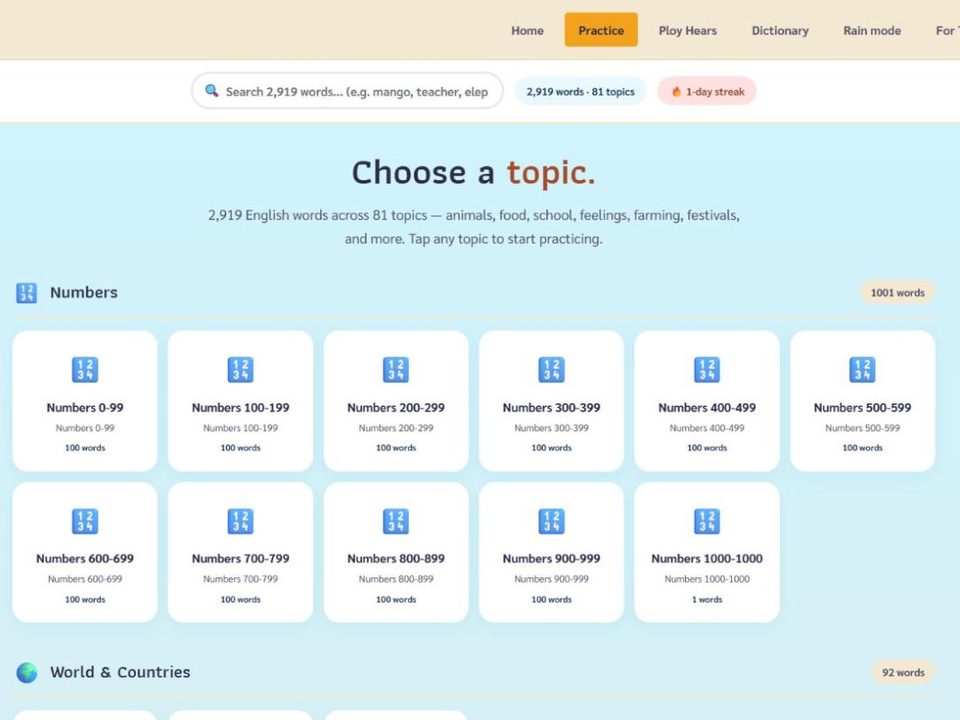
- Tools built by the author and used in this plan: EnglishTeacher.com (practice app, Ploy Hears, printable word lists), ESLteacher.com (the three-level worksheet builder with Thai gloss), USAEnglish.com (the Story Telling championship, its score sheet, lesson plans and Thai parents' page), and the recorder at benjamincunningham.com/lep/vlog/. Photographs: the author's own.