Benjamin Cunningham · Moreland University · Learning Environment Plan · Step 5 of the LEP · ED504 Module 4 · October 18, 2026
Context and principle
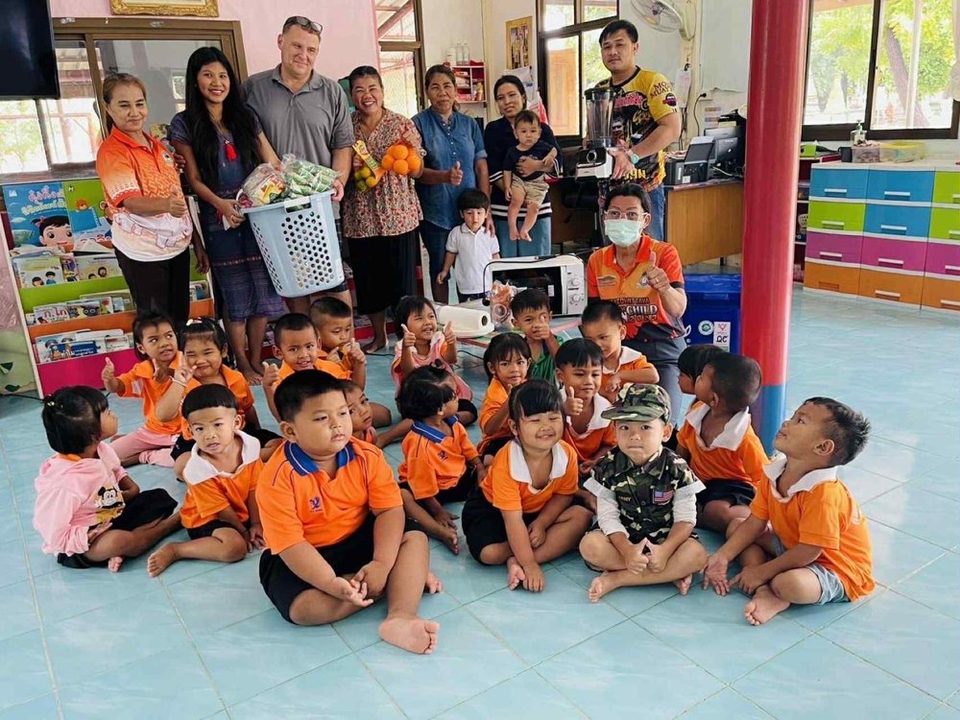
Grade band: Prathom 4–6 (ages 9–12), English as a foreign language, government village school in Rattanaburi district, Surin, Thailand. Class: 30–45 children, one foreign teacher, a Thai co-teacher; one television and one teacher's phone; a school library with few English books; most homes with no English print and one shared phone. Languages in the room: Thai (the school language), Isan (Lao, the home language of most children, spoken but rarely written), some Kui and Northern Khmer, and English as the target. Several children read Thai slowly; a few arrive from other provinces mid-year.
The principle: a child learns the words that are around them, and an English learner's words have to be put there on purpose. Neuman and Celano (2001) found that children in low-income neighborhoods had a small fraction of the print access of children in middle-income ones; in a village in Isan the gap for English print is total. So the room is built as the one place where English is everywhere, in three forms at once: on the walls (print), on the screen (digital) and in the air (oral language). The information-intensive environment is the environment the children do not have anywhere else, and it is designed around the languages they do have.
Design rules. (1) Every English text in the room has the Thai beside it; Isan, Kui and Khmer appear where the children put them. (2) Nothing depends on the internet: every digital text has a paper twin. (3) Texts are at three levels in every lesson (WIDA levels 1–3, CEFR Pre-A1–A1), so every child can read something and nobody reads nothing. (4) Children's own words go on the walls within a week of being written. (5) Words are said before they are read, and read before they are written.
Ten steps to create the environment
- Audit the room and the home (week 1). Count every English text a child can touch in the room; ask each child, through the learner survey (Step 2), who reads or tells stories at home and in which language, and whether there is a phone. In my room the audit found one English poster, zero English books a child could take home, and about one phone per household. The plan starts from that number, not from a catalog.
- The trilingual word wall. One wall, alphabet strips in English, each card English on top, Thai under it, a picture, and a blank line where a child writes the Isan (or Kui or Khmer) word. Tier 2 words from the week's lessons (Beck, McKeown and Kucan, 2013), 5 a week, 150 by term's end; cards never come down, they move to the "words we own" column. Children are the authors of the third language on every card.
- Environmental print on every surface. Door, window, fan, shelf, board, bin, the clock: labeled in English and Thai at child eye level, with the pronunciation guide from EnglishTeacher.com. The label is the text a beginner can read on day one; by P6 the labels carry a sentence ("Open the window when it is hot").
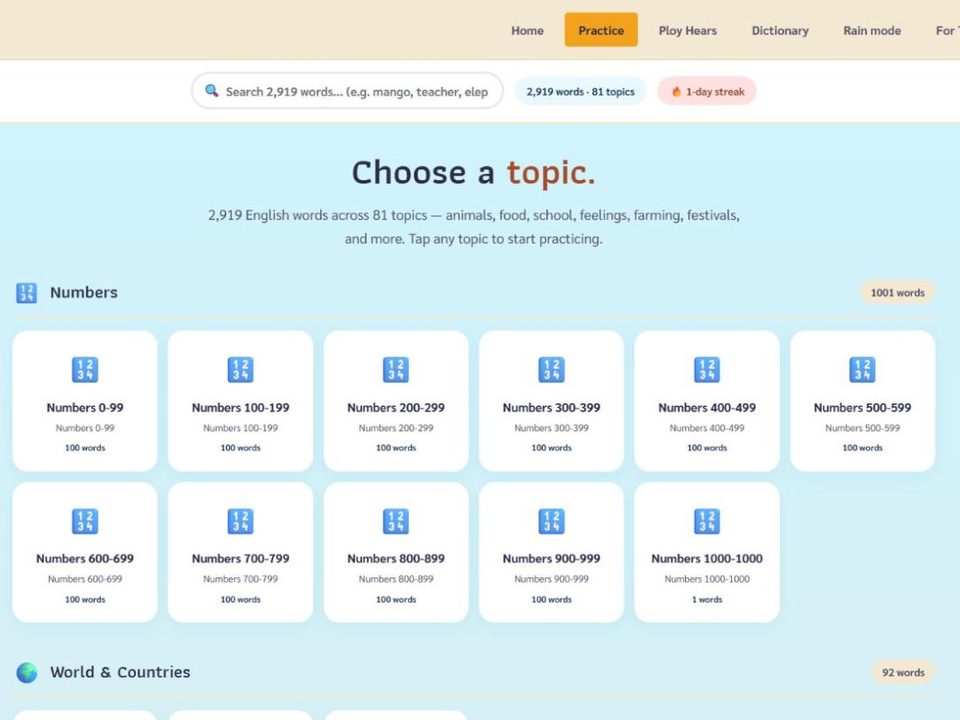
- A leveled classroom library in three boxes. Box A (WIDA 1, picture + one word): printable word lists from the 81 topics on EnglishTeacher.com, one topic per booklet, stapled. Box B (WIDA 2, sentences): the leveled reading texts from the ESLteacher.com worksheet builder, each text at three levels on three colors. Box C (WIDA 3, short stories): the Story Telling competition stories the district uses, with Thai summaries, and bilingual folk tales from Isan told by the children's grandparents and typed up (step 7). Every box has a Thai informational text too, so that reading for information is never only in English.
- The digital shelf, offline first. EnglishTeacher.com on the television: tap a word, hear it, say it back, 2,919 words; the 82,683-word English–Thai dictionary for the word nobody knows; Ploy Hears, the ten-week sound clinic, for the daily ten minutes. All of it works offline after the first open (Rain mode), so the one phone with no signal still has every word. A visiting newcomer without Thai gets the same screen with the picture doing the work.
- A listening corner. One phone, one small speaker, headphones for four. Recordings: the Story Telling stories read by the P6 winners, the week's word wall read aloud by the co-teacher and me, two songs, and a grandparent telling a folk tale in Isan followed by a child retelling it in English. Listening is the text for the child who cannot yet read it.
- Children's writing on the walls within a week. A "This week we wrote" board: every child's best sentence, typed or copied, their name, no corrections on the display copy. Class books: "Our village in English," "Rice farming words," "The festival," made from the children's sentences and photographs, kept in Box C as reading texts. The library grows out of the room.
- The storytelling stage. A taped square at the front and a microphone. Every Friday three children tell a story, a joke or the news from the village in English, chorus first, then one. Oral language is treated as a text: the best tellings are recorded for the listening corner and transcribed for Box C.
- The home link. Each child takes one printed word list home a week; a LINE message every Sunday evening in Thai, with a picture and the English word of the week recorded as a voice note, so a grandmother who reads little Thai can play it; a family storytelling invitation each term, in Isan, recorded for the corner. The home becomes part of the environment instead of the gap in it.
- Routines that make the room talk. Word of the day in chorus at the door; ten minutes of read-aloud every day, the picture before the words, the Thai after; "say it three ways" (English, Thai, Isan) for new words; a word-wall quiz on Friday run by the children. Signals, turn-taking and jobs follow Step 4, so the information-rich room is also a predictable one.
Developmentally appropriate texts by grade
| Grade | Language level | Informational texts | Literary texts | Digital | Oral |
|---|---|---|---|---|---|
| Prathom 4 (9–10) | WIDA 1–2 · CEFR Pre-A1 | Labeled pictures; the Animals, Food, Classroom and Rice Farming word lists; a bilingual weather chart the class fills in | Picture stories with one sentence a page; a folk tale told in Isan, retold in English by the class | EnglishTeacher.com topics; Ploy Hears week 1–4 sounds | Chorus, songs, "say it three ways"; show-and-tell with a prop |
| Prathom 5 (10–11) | WIDA 2 · CEFR Pre-A1–A1 | Leveled texts from the worksheet builder on village life, the festival, the body; bilingual signs and packaging read in class | The district Story Telling stories with Thai summaries; class-made books | Dictionary look-ups; recorded stories in the listening corner | Pair retelling; the Friday stage with a partner |
| Prathom 6 (11–12) | WIDA 2–3 · CEFR A1 | Short informational texts at three levels on topics the children chose; a simple English news item a week with Thai gloss | Longer stories, a play script for the stage, the children's own stories from the competition | Students record their own readings; a class word bank they edit | The Friday stage alone; interviewing a grandparent and reporting in English |
ESL methods: materials and methods that reflect the class's cultural and linguistic diversity
Methods and materials. Funds of knowledge (Moll, Amanti, Neff and González, 1992): the children's households are the first source of texts. The rice-farming word list, the festival book, the grandparents' folk tales and the village news are the content; the children and their families are the experts and I am the English. Translanguaging on purpose (García and Wei, 2014): the word-wall card has three lines, pairs may settle meaning in Isan before answering in English, and a child's Kui or Khmer word is written on the wall with their name. Mentor texts from our own district: the Story Telling competition stories, and the story of a girl from this district who won gold in it and now teaches here, read as a class text. Bilingual environmental print, bilingual home messages, and a listening corner where the children's own voices and their grandparents' voices are the recordings.
How they reflect and respond to diversity. Every text carries the home language or the home content or both, so the Isan-dominant child, the Kui speaker and the newcomer each see themselves in the room before they are asked to produce English. The three-level library means a P6 child reading at WIDA 1 and a P4 child reading at WIDA 3 both have a text; levels are by language, not by age or grade. A child who reads Thai slowly is reached by the picture, the audio and the label before the sentence. A newcomer without Thai is reached by the picture and the screen. The materials respond because the children make half of them: a wall of words the class wrote cannot leave anyone out.
Leveraging diversity for relationships and growth. When a child is the only one in the room who can give the Kui word, the room needs that child; status in the class is tied to what each child knows, not only to English. Grandparents whose Isan stories are on the listening corner are in the classroom without entering it, and the child whose grandmother's voice is playing sits taller. Academically, the word that has a Thai and an Isan anchor is remembered; linguistically, the child who has told the story in Isan has the structure and only needs the English, which is the point of allowing the home language on the way to the target one (Cummins, 2000).
Why these methods, and what the research says. The design is culturally sustaining rather than culturally responsive: Paris (2012) and Paris and Alim (2017) argue that a classroom should sustain the languages and literacies children bring, not use them as a bridge and then drop them, which is why the Isan line on the word card stays after the English is learned and why the grandparents' stories are permanent texts in Box C, not a one-week unit. The class books are identity texts in Cummins and Early's (2011) sense: writing in which children see themselves and their families reflected, which they then read with pride to an audience, and which carried the strongest literacy gains for multilingual learners in their study. Echevarría, Vogt and Short's SIOP model (2017) supplies the lesson-level routine, building background and comprehensible input, so that every text in the room is introduced with its picture, its Thai and its home-language link before the English is read. None of this requires money; it requires the room to treat what the children already know as the first text.
| Material or method | Cultural or linguistic asset it uses | Social language it builds | Academic language it builds |
|---|---|---|---|
| Trilingual word wall (English · Thai · Isan/Kui/Khmer line written by a child) | Home languages; the child as the authority on their own language | Everyday words of the room, "say it three ways" | Tier 2 words from the week's lessons, 150 a term |
| Rice-farming, festival and village word lists and class books | Funds of knowledge: farming, Buddhist and Isan festivals, local trades | Talking about home and village life in English | Informational text about a topic the child is already the expert in |
| Grandparents' folk tales recorded in Isan, retold in English | Oral tradition; elders as co-teachers | Narrative talk, retelling to a partner | Story structure, sequence words, past tense |
| District Story Telling stories and the Rattanaburi gold medalist's story | A local model of success in English | Performing for an audience, the Friday stage | Memorizing and analyzing a mentor text |
| EnglishTeacher.com and the English–Thai dictionary on the television | Thai as the medium of explanation; works offline for homes without signal | Pronunciation, listen-and-repeat, word games | Dictionary use; 81 topic word sets aligned to the curriculum |
| Three-level library (WIDA 1–3) | Every language level in a mixed-age, mixed-level room, including a newcomer without Thai | Reading with a partner at the same level | Volume of reading, which drives vocabulary and knowledge |
| Bilingual LINE home link with a voice note | Grandparents who read little Thai; one phone per house | The word of the week spoken at home | Homework a family can supervise in Thai |
| Identity class books ("Our village in English") | Children's own lives, photographs and sentences | Reading one's own writing to the class | Writing informational text; editing a class word bank |
The connection to ELLs' academic and social language. Social language (Cummins's BICS) grows on the stage, in the chorus, in show-and-tell and in the labels: the English of the room and the day. Academic language (CALP) grows in the informational texts, the Tier 2 word wall and the class books: the English of reading to learn. An information-intensive room holds both at once, and the environmental print is the bridge, because "window" on the wall is social and "temperature" on the weather chart is academic, and both are read every day. For an English learner who has no English outside the room, the density of the room is the whole input; thin walls mean thin vocabulary.
How oral language and the environment build reading and writing
Oral language is the root of reading: the National Early Literacy Panel (2008) identified oral language, including vocabulary, as a predictor of later reading comprehension, and Storch and Whitehurst (2002) traced the path from preschool oral language through code skills to reading. For an English learner the path is the same but starts later and in a second language, so the order of the room is spoken first, read second, written third. The chorus at the door gives the sound; the word wall gives the spelling; the Friday stage gives the sentence; the writing board gives the written form a week later.
Vocabulary is the hinge. Beck, McKeown and Kucan's Tier 2 words are learned through repeated, meaningful encounters, and a room where the word is on the wall, on the screen, in the listening corner and in the child's own sentence supplies those encounters without a worksheet. Cunningham and Stanovich (1998) showed that volume of reading drives vocabulary and general knowledge; the three boxes and the take-home list are there to make volume possible for a child who owns no English book. Writing follows: a child who has said the sentence three ways and read it on the wall can write it, and the "talk to write" routine (say it to a partner, then write it) is how every piece of writing in the room begins.
Reflection: how this environment will shape the classroom climate
An information-intensive room changes who is competent in it. In a bare room, the child with the most English is the only expert; in this room, the child who knows the Isan word, the child whose grandmother told the story, the child who drew the festival book cover and the child who read the weather chart aloud are all experts for a moment, and climate is built out of those moments. Vocabulary is also safety: a child who has a word for the thing is less likely to stay silent, and the walls give them the word before they have to ask for it. The routines that put the words in the air (chorus, say it three ways, the stage) are the same routines from Step 4 that keep the room predictable, so richness and order are the same system, not competing ones. The risk is clutter and noise, and the controls are the audit (what is on the wall is used, or it comes down), the three-level rule (every text has a level), and the Friday word-wall quiz, which tells me whether the words are landing. If the walls are read, the room is working; if they are decoration, I have built a display, not an environment.
How I will know it works
| Measure | How | Target by week 8 |
|---|---|---|
| Words owned | Friday word-wall quiz, children run it; a word moves to "owned" when 80% of the class says it correctly from the picture | 60 words owned; every child owns 30 |
| Reading volume | Box sign-out sheet; take-home list returned with a tick from the family | Every child takes one text home a week; 80% of lists come back |
| Oral turns | Tally of children who spoke alone on the Friday stage | Every child has told a story alone at least once |
| Writing on the wall | Count of children with a sentence on the "This week we wrote" board | 100% every week |
Discussion points used in the Virtual Class
2020. I was not teaching when schools closed in 2020; I began at Ban Han Hee later. Thailand's answer was DLTV, lessons broadcast on television, and LINE groups run by homeroom teachers; in villages like ours the limits were one phone per household, patchy signal and grandparents as the adults at home. If I had been teaching, the plan would have been the one I run now for the home link: paper first (a printed bilingual word list delivered to the house), audio second (a voice note in Thai for the grandparent), the app third (EnglishTeacher.com works offline after one open), and a weekly phone call to every family rather than a daily video class that most could not join.
Access now. Three boxes at three levels, every digital text with a paper twin, every English text with its Thai, and a take-home list a week. Access is a question of levels and languages, not only of quantity.
Vocabulary and climate. The walls give a child the word before they have to ask for it; a room where every child can name the things in it is a room where every child can speak. Words the children wrote themselves on the wall make the room theirs.
Oral language. Spoken first, read second, written third. Oral language carries the vocabulary and the sentence structure that reading and writing then use; for an English learner it is the only place the English exists before the page.
References
- Beck, I. L., McKeown, M. G., & Kucan, L. (2013). Bringing words to life: Robust vocabulary instruction (2nd ed.). Guilford Press.
- Cummins, J. (2000). Language, power and pedagogy: Bilingual children in the crossfire. Multilingual Matters.
- Cunningham, A. E., & Stanovich, K. E. (1998). What reading does for the mind. American Educator, 22(1–2), 8–15.
- Cummins, J., & Early, M. (Eds.). (2011). Identity texts: The collaborative creation of power in multilingual schools. Trentham Books.
- Echevarría, J., Vogt, M., & Short, D. J. (2017). Making content comprehensible for English learners: The SIOP model (5th ed.). Pearson.
- García, O., & Wei, L. (2014). Translanguaging: Language, bilingualism and education. Palgrave Macmillan.
- Moll, L. C., Amanti, C., Neff, D., & González, N. (1992). Funds of knowledge for teaching: Using a qualitative approach to connect homes and classrooms. Theory Into Practice, 31(2), 132–141.
- National Early Literacy Panel. (2008). Developing early literacy: Report of the National Early Literacy Panel. National Institute for Literacy.
- Paris, D. (2012). Culturally sustaining pedagogy: A needed change in stance, terminology, and practice. Educational Researcher, 41(3), 93–97.
- Paris, D., & Alim, H. S. (Eds.). (2017). Culturally sustaining pedagogies: Teaching and learning for justice in a changing world. Teachers College Press.
- Neuman, S. B., & Celano, D. (2001). Access to print in low-income and middle-income communities: An ecological study of four neighborhoods. Reading Research Quarterly, 36(1), 8–26.
- Storch, S. A., & Whitehurst, G. J. (2002). Oral language and code-related precursors to reading: Evidence from a longitudinal structural model. Developmental Psychology, 38(6), 934–947.
- WIDA. (2020). WIDA English language development standards framework, 2020 edition: Kindergarten–grade 12. Board of Regents of the University of Wisconsin System.
- Materials: EnglishTeacher.com (2,919-word bilingual practice app, 82,683-word dictionary, Ploy Hears clinic), ESLteacher.com (leveled worksheet builder), USAEnglish.com (Story Telling lesson plans), all built by the author for Thai classrooms. Photographs: the author's own, Ban Han Hee School and Rattanaburi.
← Step 4 · Transitions · All courses · Record the Module 4 vlog · Next: Step 6 · Technology Tools →